When people think of Illinois they typically imagine flat cropland or big cities like Chicago or Springfield. Most cannot imagine the vast and awe inspiring diversity of the southern Illinois region unless you’ve seen it with your own eyes. Think beautiful fall foliage changes overlooking varied topography and breathtaking bluffs, caves, cliffs, and waterways. Pope County, Illinois, in southern Illinois, has a complex and dramatic geological history mainly due to the intersection with major tectonic fault systems. Our area’s unique geology is thanks to early Pennsylvanian sandstones and older Mississippian limestones that were largely unaffected by the flattening glaciers that once were prevalent in the area.
Pope County, Illinois is part of the Fluorspar Area Fault Complex, an intricate array of fractures. The complex runs through Pope, Hardin, and Massac counties in Illinois and extends into Crittenden and Livingston counties, Kentucky.
Why are fault systems even important?
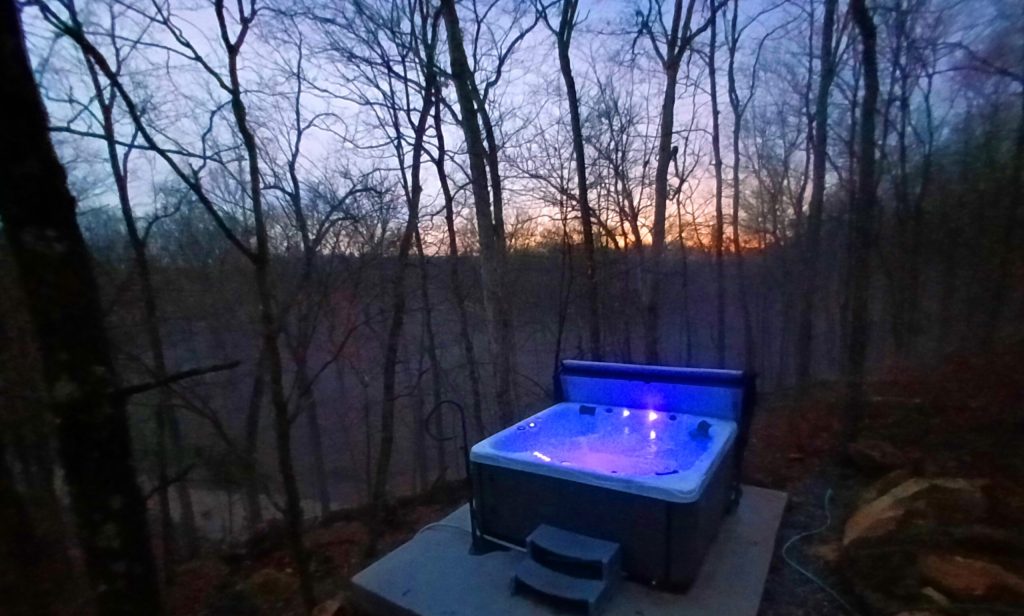
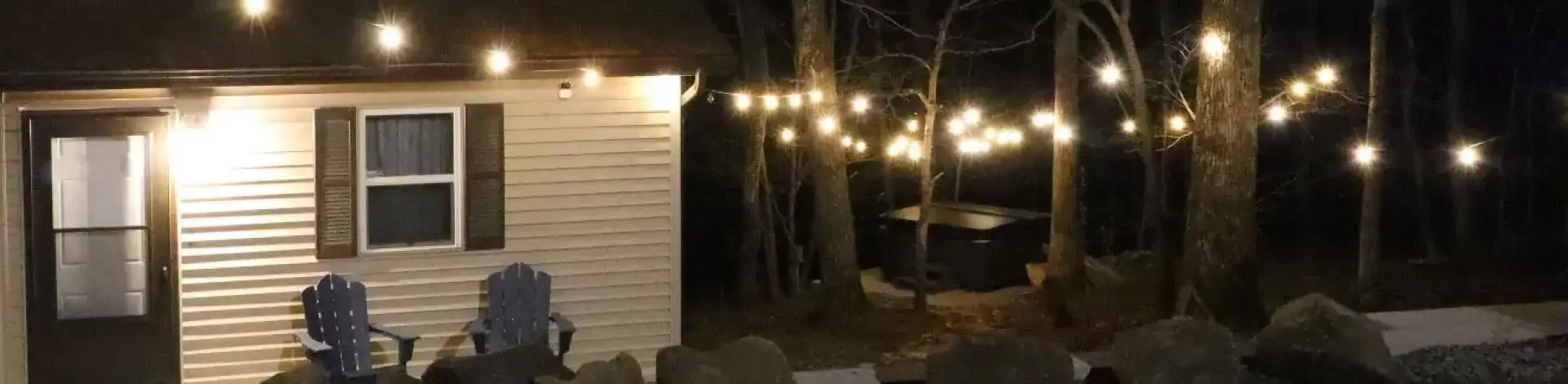
Our area’s unique geography and faults played a huge part in making our southern Illinois couple’s cabin such a unique, nature lover’s retreat with the amazing views! Shawnee Forest Hideaway is situated in a very rocky outcropping overlooking a stream that feeds into the Lusk Creek waterway nearby which also feeds into the Ohio river. Our outdoor spaces are designed to feature the natural beauty of the surrounding forest. The stone path leading down the hill to our hot tub perfectly meshes outdoorsy but with modern comforts during any season. We just love how water naturally rushes down around the cabin and into the area waterways, it is a haven for wildlife and the perfect spot to just relax and unwind.
Folks from Chicago, Springfield, St. Louis and Evansville flock to southern Illinois to behold the natural beauty of the area and the geography, the faults, the mineral resources and the wildlife are why people come.
Curious about more geological history of Pope County, Illinois?
Here is how it all began (as sourced from the Illinois Department of Natural Resources):
- Precambrian to Cambrian: The foundation of the region was laid 1 billion to 0.6 billion years ago. Later, tectonic forces began pulling the crust apart (rifting) in the late Precambrian to Early Cambrian.
- Paleozoic Era (Sea & Delta): From 543 to 323 million years ago, the region subsided, becoming a shallow, tropical sea. This ocean deposited thick layers of limestone (containing shells, algae, and corals) and sandstone.
- Carboniferous Period (Swamps): During the Mississippian and Pennsylvanian periods (roughly 323 to 290 million years ago), the ocean retreated and was replaced by massive river systems and deltas. Vast swamps covered the area, which later became coal beds, while rivers deposited sand that formed the prominent sandstone cliffs.
- Tectonic Activity (Faulting): Intense tectonic movement occurred during the late Paleozoic (Permian period, roughly 250–325 million years ago). This created major faults and the Illinois Basin, a spoon-shaped depression.
- Post-Paleozoic to Present: The region has been subjected to erosion and uplift. While continental glaciers covered 85% of Illinois during the Pleistocene (1.6 million to 10,000 years ago), the rugged Shawnee Hills of Pope County were largely bypassed.
Erosion and Landscape
The topography of Pope County is characterized by north-facing cuestas (slopes) and south-facing escarpments (cliffs) formed by differential erosion, where harder sandstone holds up ridges and softer limestone erodes faster. The Cache Valley, a major feature, represents a former course of the Ohio River.
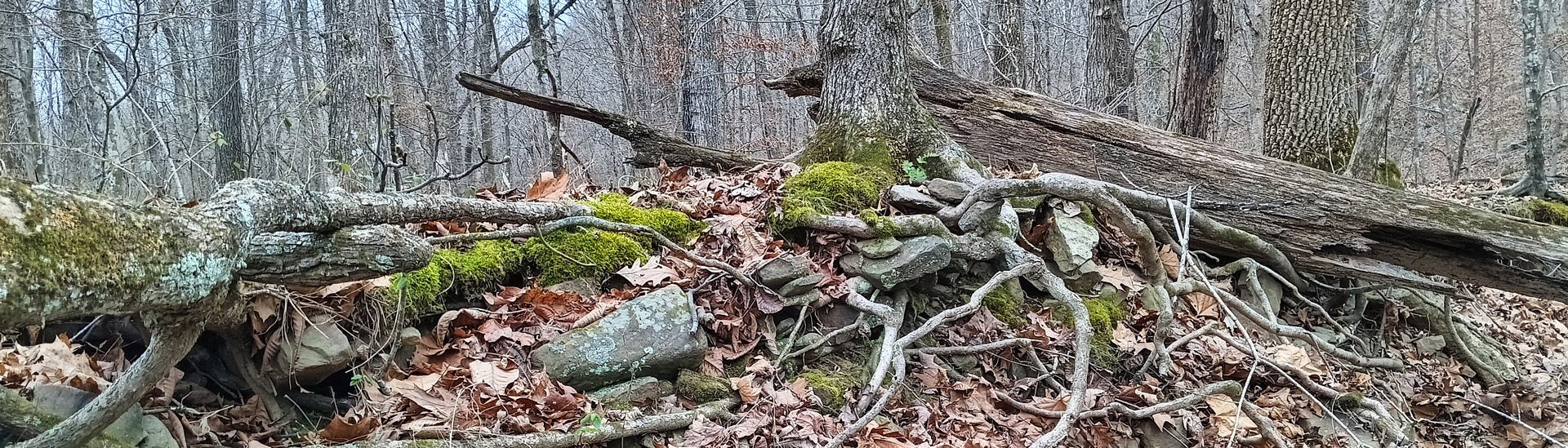
While exploring at Shawnee Forest Hideaway you will find the very same sandstone, limestone and water erosion that is characteristic to the area.
Did you know we have a dormant volcano nearby?
Hicks Dome is a nearby a unique, roughly 10-mile-wide dormant volcanic structure in neighboring Hardin County, Illinois, acting as a major geological hotspot for rare earth elements, thorium, and fluorspar. Formed by a deep-seated carbonatite intrusion, this subsurface feature features breccia, alkaline-ultramafic rocks, and significant concentrations of critical minerals. Get directions to Hicks Dome from Shawnee Forest Hideaway here.
Want to visit unique, less known natural wonders of the area? Enjoy our southern Illinois geography at:
Dixon Springs State Park– The park is situated on a large block of 315-million-year-old sandstone that dropped 500 feet along a fault line, creating its unique topography. Dixon Springs State Park, located in southern Illinois, boasts a rich history as a Native American campsite (the “Great Medicine Waters”), a 19th-century health spa, and a 20th-century state park. Known for its mineral springs and scenic canyons, it was officially purchased by the state in 1946 after serving as a popular resort area. While you are there you can stop by The Chocolate Factory for ice cream or sweets! Both are just 12 miles from Shawnee Forest Hideaway.
Pope County Historical Society Museum – Whose goal is to discover and preserve important artifacts and information related to one of the oldest counties in Illinois! Formed in 1816, Pope County is in the southeastern corner of Illinois. Notable exhibits are a real mammoth tusk discovered along the Ohio River, an old Studebaker wagon, an egg crate machine, and a copper still. This is 2.9 miles from Shawnee Forest Hideaway. Nearby you can also dine at Diver Down, a local bar and grill with a fun atmosphere.
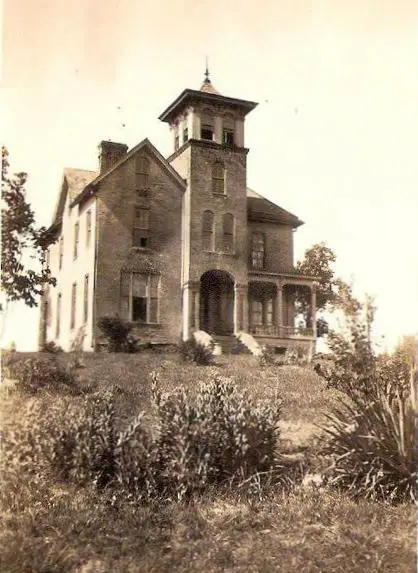
Rauchfuss Hill Recreation Area – This is a beautiful destination resting on a bluff overlooking the Ohio River, just north of Golconda. Historically, it was the site of a “castle-like” mansion built in 1884, which burned in 1929. Following years of closure due to funding shortages, it reopened for recreation in 2021. This local treasure offers so much to visitors in the way of peaceful river views, hiking trails and picnic and camping spots. Located just 2.3 miles from Shawnee Forest Hideaway. Find directions here.
The Historic Great Salt Spring in Equality, Illinois – is a historically significant, natural, saline spring located in Gallatin County near the Saline River. Known for supplying salt to Native Americans for thousands of years, it later became the financial center of Southern Illinois. Today, it is an accessible, yet, quiet, site off Salt Well Road. This is 33.8 miles from Shawnee Forest Hideaway.
The Village of Makanda – Makanda has a rich history which started as a camp for the Illinois Central Railroad. Present day Makanda has become an affordable place for artists from Southern Illinois University and the surrounding areas to create and display their work downtown on the boardwalk. Our family loves the local rock shop and the ice cream and coffee place. This is 56 miles from Shawnee Forest Hideaway but is well worth it and will put in the neighborhood of Giant City State Park and near the Shawnee Hills Wine Trail if those interest you.
To summarize, southern Illinois, specifically Pope County, is a wonderful place to consider visiting. We have lots of less known, nature related wonders to behold. Everyone comes for the well known Shawnee National Forest, the hikes at Garden of the Gods, Jackson Falls, Burden Falls, etc but there is even more to explore if you dig deeper!
Looking for the perfect hot tub cabin for two in the heart of the Shawnee National forest? Check out our cabin: Shawnee Forest Hideaway in Golconda, Illinois on airbnb.